|
|
|
|
|
 |
|
 |
|
|
|
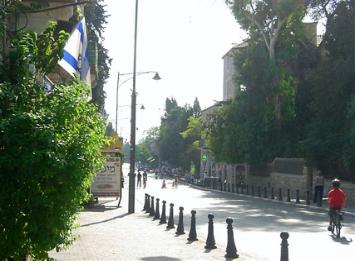
Emek Refaim on Yom Kippur
|
|
|
|
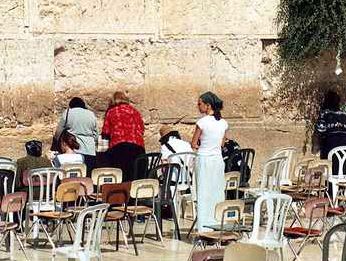
Women Praying at the Western Wall
|
|
|
|
 |
|
 |
|
|
|
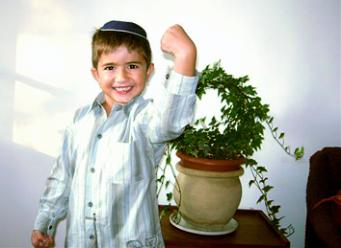
Five and a Half and Ready for the New Year
|
|
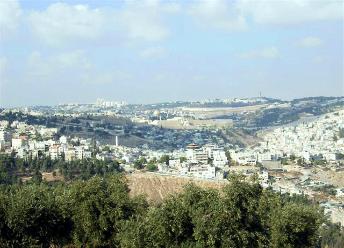
Jerusalem from the Haas Promenade
|
|
|
|
|
|
 |
|
|
|
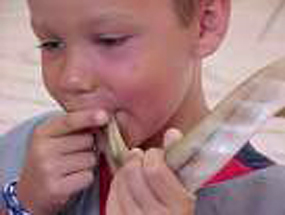
Shofar Boy, Used by Permission
|
|
Since my birthday (September 22) was followed immediately by the Jewish New Year, I was
determined to hear a real, live shofar herald the coming year of my life (not to mention everyone
else's). So on the morning of Rosh Hashana, I walked to the Western Wall where from a distance I
watched as various men (of varying talent, I might add) blasted in the New Year. I needn’t have
bothered. By early evening my street was alive with the sound of countless children playing their own
little shofars, like so many tiny bleating lambs.
The Days of Awe leading up to Yom Kippur seemed relatively ordinary except for the New Year’s
greeting “Shana Tova!” But the Eve of Yom Kippur was unlike any other day. By early afternoon
shops and restaurants were shuttered, the buses stopped running, and the streets were emptied of
cars and swept. As the darkness fell, I could hear families here and there in the neighborhood singing
together “Baruch Atah Adonai, Eloheinu…” In the spirit of celebration, my neighbor’s grandson ran
up from downstairs to say “Shalom” to me and I took his picture.
Yom Kippur morning I returned to the Western Wall, found a chair in the women’s section and
stayed a couple of hours reading Psalms, praying, and listening to the men singing across the way.
There weren’t a lot of people there because most everyone goes to synagogue. In fact, when I
glanced at the text a woman seated near me was reading, I couldn’t help but smile: 1 Corinthians.
How many of the women at the wall on Yom Kippur were Christians? Well, Christendom does have
some repenting to do, especially with regard to the Jews, and what better day for it?
In Jerusalem, Yom Kippur is not only a fast of water and food, but a complete shutdown of the city:
no cars, no buses, no radio, no television, no markets or restaurants or shops or work of any kind.
The wonderful byproduct of all this is almost complete silence. I say “almost” because all is not
solemn. The streets are full of kids on bikes—riding fearlessly and frenetically because there is no
traffic. And some Jews, especially those from North Africa, dress entirely in white. I walked by as
they sat in large groups at the park, chattering and laughing.
Just before sunset I walked to the Haas Promenade. Looking across the valley, I saw the Old City
fall into shadow, as the golden dome paled and the streetlights flickered on. Stars began to appear,
and as I left, the siren went off, officially ending the holiday. Just a couple of minutes later, I found
myself outside a synagogue where several dozen women and children were crowded into an outside
courtyard. Through a window I watched the men worshipping. I was only there a couple of minutes
when the shofar sounded once again—this time ending the service and the Holy Days, and sending
the worshippers home to break their fast and start the New Year with a fresh, clean beginning.
So began, for me, the year 5767 in Jerusalem: new city, new year, new beginning. And so I wish
Shana Tova to all my friends and family, and I thank you for taking time to share these moments
with me.
High Holy Days in Jerusalem, September 23 through October 2, 2006