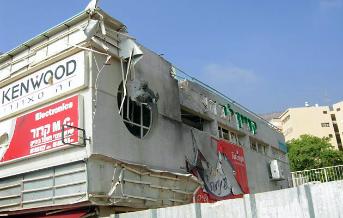
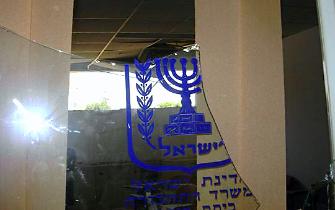
Kiryat Shmona mini mall
Kiryat Shmona:
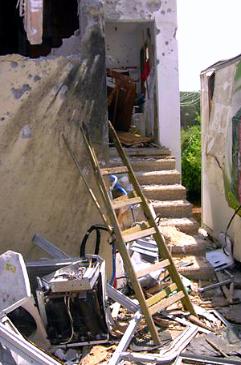
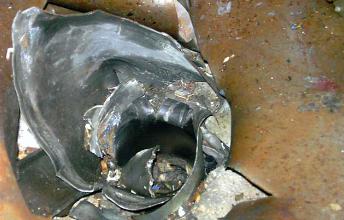
house Katushya damage
Kiryat Shmona Katushya
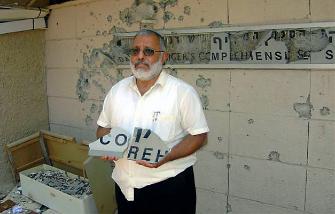
Inside the mini mall
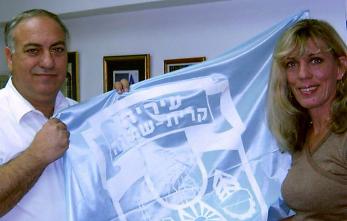
With the Mayor
Yakaav, a teacher at the high school


By Tuesday, August 22, the ceasefire had held for more than a week, so along with Shannon Shibata
and Avihu Cohen of StandWithUs (
www.standwithus.com), I visited Kiryat Shmona, located at
Israel's northern border with Lebanon (see map). A small city, with a population of 24,000, it
endured more than 1,000 Katushya rocket strikes in recent weeks, launched by Hizbollah to
intentionally target civilians. Around 2,000 homes were damaged, 150 people were wounded and
twelve people were killed in a nearby kibbutz. We spoke with the city's mayor, Haim Barbibay, who
proudly told us that he sees Kiryat Shmona as the "Northern Gateway to the Jewish State," and that
for every house that was destroyed "…we will build 10 more, and for every tree that was burned we
will plant ten more. This is the Israeli way." It is truly a city of unsung heroes. Meanwhile, the
mayor's PR representative, Susan Peretz (originally from New Jersey) was less sunny: "We lived in
an inferno for four weeks. It was a nightmare—I've been through 6 wars and this was worse than all
of them. Parts of the city have been reduced to cinders. We know that this war was not, in actual
fact, between Israel and 1,000 Hizbollah guerrilla fighters. We know that we are facing the armies of
Iran and Syria." Susan said what many others told us as well—that they would have voluntarily
stayed in the bomb shelters—hot, cramped and miserable as they were—for weeks longer, in order to
allow the IDF to complete disarming of Hizbollah in Southern Lebanon. The UN-brokered ceasefire
aborted the Army's efforts, however. And everyone expressed the same conclusion in so many words:
"It's just a matter of time, months if not weeks, before the fighting erupts and the rockets start
blowing the city apart again."

At the local high school, we spoke with Yaakov, a physics teacher, who shows us the three different
areas on the campus that were damaged by rockets. School is supposed to reopen September 2, but
there is much to be done for that to be possible.

While looking for the high school, we drove past a ruined home, stopped and talked to the owner—
Maurice Mamann. He explained to us that he, his wife and four children had fled the city and were
staying with friends in Jerusalem when they saw their damaged house on television. They rushed
back to find nearly half of it in ruins. We went inside and saw for ourselves the sorry remains of the
kitchen, laundry area, and children's bedrooms. We also looked into the outbuilding where the
Katushya is still embedded in the floor—it made a direct hit on the house, then careened into the
outside storage building.

We also drove past a mini-mall in another part of the city. The shattered glass in one area bore the
image of the Israeli menorah, which symbolically spoke of physical damage not only to the
community of Kiryat Shmona, but to Israel itself. The trauma to ordinary citizens and especially
children—the intentional targets of the 7,000 Hizbollah rockets launched into Israel during the war—
is incalculable. But, as the mayor told us, "The hand of God saved us, and we will rebuild. We have
always wanted peace, and to be good neighbors to the Lebanese. Someday it will be so . . ."
August 25, 2006
Home